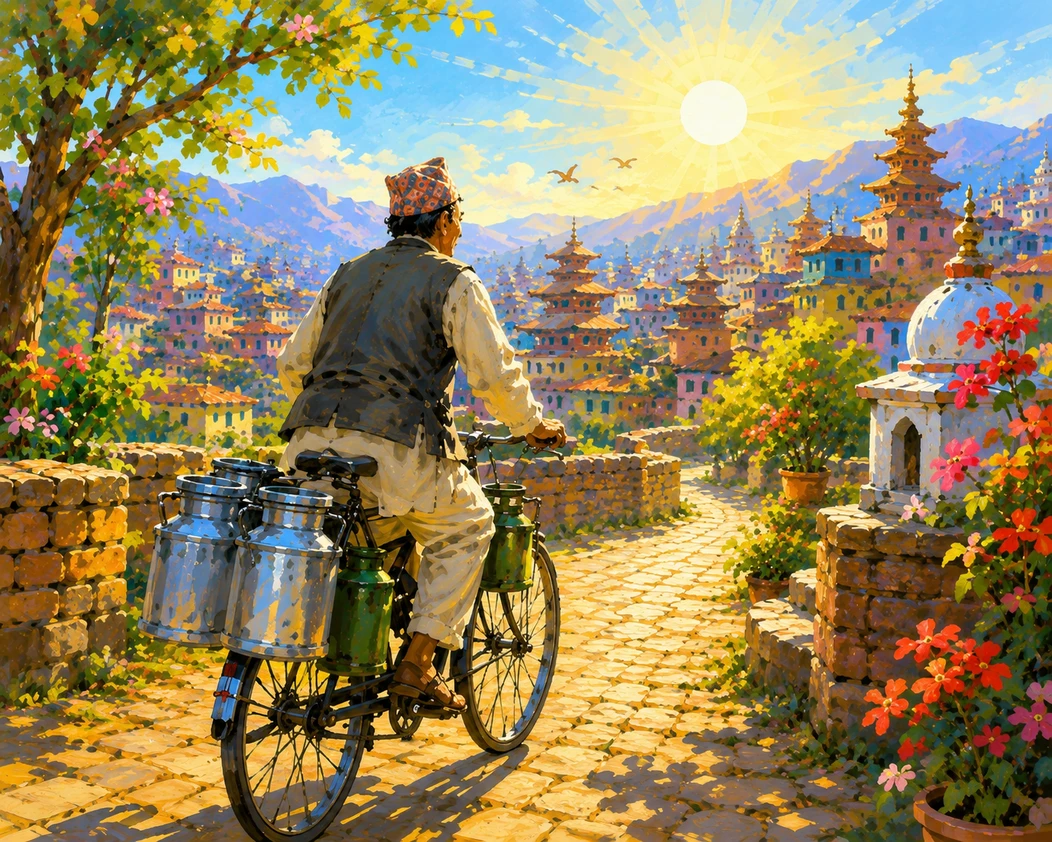
The milkman was an ugly man. Or perhaps that is only what I was taught to believe.
Do we truly have the right to measure another human being by the accidents of their face? Perhaps not. Yet some lessons enter us long before reason does, quietly inherited through kitchens, courtyards, gossip, and laughter. I grew up hearing that the milkman had been bringing milk to our house since before I was born, nearly twenty years ago. Even now, in memory, he remains the alternate alarm clock of our family — arriving before dawn, before sunlight, before the city had properly awakened.
We called him “gwala dai” — gwala meaning milkman, and dai meaning elder brother in Nepali.
His face carried the map of a thousand scars. They looked like deep pox marks scattered across dark skin weathered by seasons, labour, and sunlight. Beneath them sat two tiny deep-set eyes and a crooked nose that seemed permanently bent by fate itself. Handsome was never a word anybody would have used for him. Yet somehow, through all those years, the smile on his face never abandoned him. Those small eyes, despite their size, always seemed strangely deep, almost unsettlingly observant, carrying a sly glimmer as though they knew more about the world than they ever revealed.
I never saw him without his daura suruwal and Nepali topi. At a time when satellite television and the internet had convinced Nepalese men to imitate the West, when many dreamed of becoming “Amrikan” in manner and appearance, gwala dai continued wearing his traditional clothes with quiet dignity. I often wondered if patriotism flowed through those veins, or whether simplicity itself had become his final rebellion.
Then there was the smell.
An unforgettable, overpowering mixture of milk, curd, ghee, and livestock followed him everywhere like an invisible cloud. It was as if the entire Lagankhel dairy had entered our house each morning. Perhaps it was this smell, or perhaps something crueller and more ancient, that made him an unwelcome visitor. The maids snapped at him for reasons nobody could explain. They hurled insults as casually as one throws scraps to stray dogs. The male workers stared at him with a strange, simmering disgust, as though hatred itself could wound him.
And yet there was nothing threatening about him.
He was no Shah Rukh Khan, no Rajesh Hamal, no man whose beauty could provoke envy or insecurity. There was absolutely nothing glamorous about him. Nothing polished. Nothing powerful. Nothing fashionable. And still, he became the easiest target in the room. I often wondered whether those scars had somehow stripped him of his humanity in the eyes of others. Or perhaps the workers simply needed someone weaker than themselves — someone upon whom they could unload their frustrations and rehearse their small, cowardly performances of power.
Looking back now, I realize the infection had reached me too.
For reasons I could neither explain nor justify, I disliked him as well. Was I taught to despise him? Was contempt inherited like language? I do not know.
At the end of every month, he would arrive at our house to collect payment. And almost ritualistically, sharp voices would explode from the kitchen.
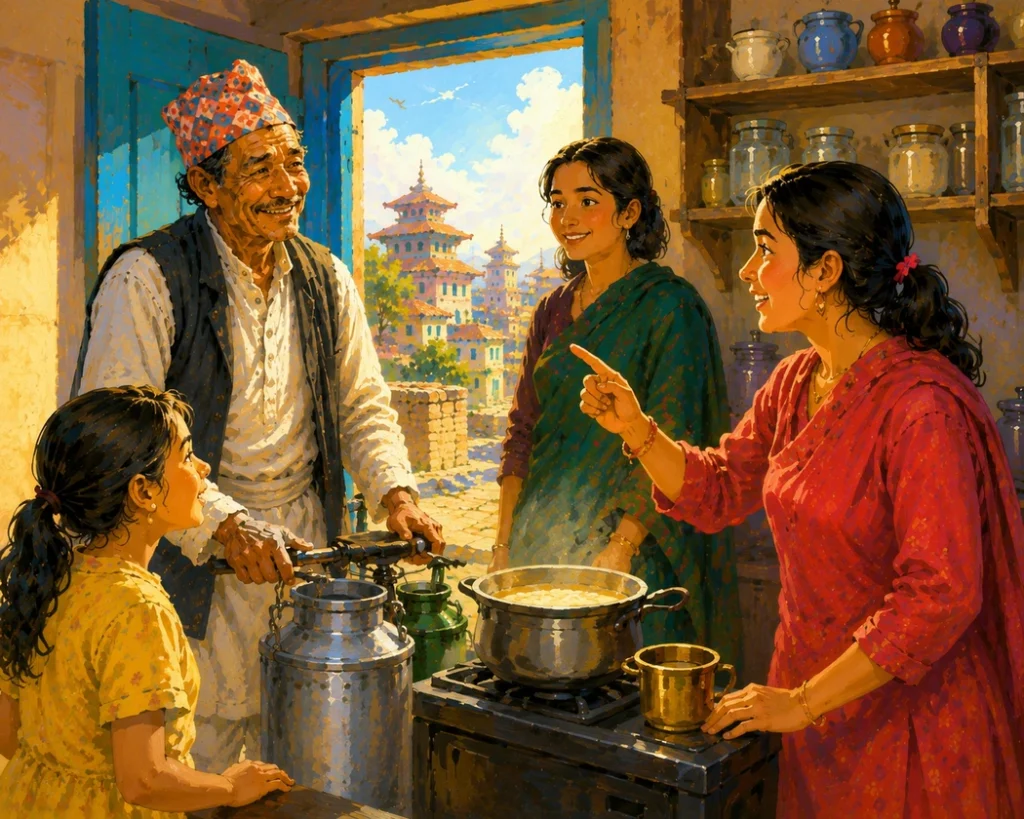
“Your milk is no good.”
“You’re cheating us.”
“Wait quietly or leave.”
The insults came from all directions at once. I used to wonder whether his scarred face somehow transformed ordinary people into crueler versions of themselves. Did nobody remember that he, too, was made of flesh and bone? Did every household greet him this way? He was not committing a crime. The gardener came monthly for payment. So did the garbage collector. Yet they were not mocked, not ridiculed, not treated as though their presence polluted the air.
In truth, he brought comfort directly to our doorstep.
Only now, living abroad, do I fully understand what a luxury that was.
Here, I wake early and rush to grocery stores for milk before work. Shelves overflow with choices — skimmed milk, low fat, full cream, high calcium, organic, lactose free — endless varieties wrapped in clean cartons beneath fluorescent lights. Yet tea never tastes quite the same. Sometimes I find myself wondering what gwala dai’s milk would have looked like packaged neatly in supermarket cartons. Would the label have carried his weathered face? Would it have been called “Gwala Dai’s Home Brand”? Or would the modern world have erased him entirely and replaced him with some polished corporate fantasy?
I had heard stories about his sons working abroad, earning large sums of money. The maids often used this against him.
“Why charge so much for milk when your sons are rich?”
I never understood those comments. Nor did I understand his silence. Perhaps resilience had become second nature to him. Perhaps he possessed the rare dignity of people who know suffering too intimately to waste energy defending themselves. Or perhaps he belonged to a generation of men taught never to answer back to women, regardless of humiliation.
Once, my mother even tried discontinuing his service. But the next morning he arrived in protest, creating a small uproar at our gate.
“Madam,” he had pleaded, “how can you say this? I started bringing milk before Maiya was even born.”
Something in those words must have softened my mother. He stayed.
Gwala dai lived in Chapagaon, a village far from Kathmandu. Whenever we drove past that area, somebody in the car would inevitably say, “This is gwala dai’s village.” Every morning before sunrise, he cycled enormous distances from Chapagaon into the city, balancing heavy containers of milk on his old bicycle. From Ekantakuna to Jawalakhel, from Kupondol to New Road, his mornings disappeared into roads, sweat, cold air, and repetition.
But he was more than a milkman.
He carried stories.
At every house, he gathered fragments of lives — gossip, rumours, marriages, land deals, scandals, illnesses — and transported them from one neighbourhood to another like a wandering newspaper on two wheels. If someone was selling land, he informed my parents. If somebody had family troubles, somehow he knew. He knocked on doors endlessly until someone answered. Alongside delivering milk, he worked as an informal broker, negotiating life through persistence alone.
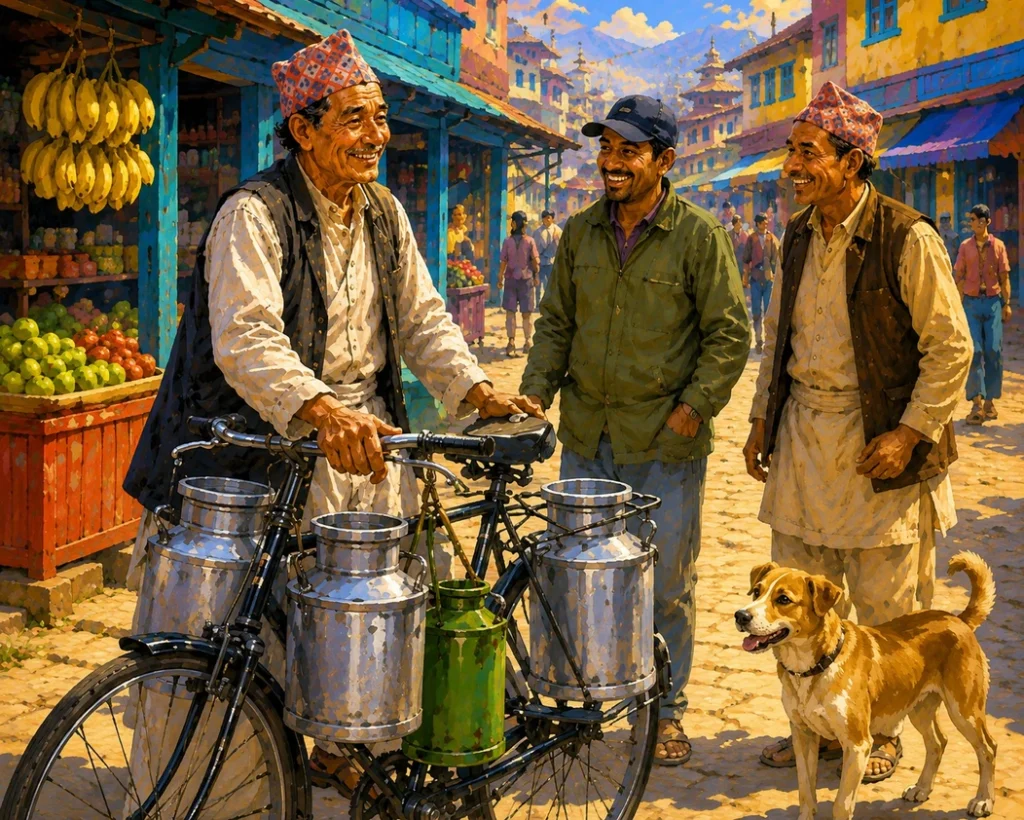
With me, however, he was always gentle.
He called me “Maiya.” He constantly reminded me how chubby and adorable I had been as a child, how tall I had grown. We rarely spoke beyond greetings, except on those rare mornings when I woke before dawn.
“Maiya,” he would laugh, “even old people are jogging on Ring Road now. Why are you still sleeping?”
I must have heard that question a hundred times.
How could I explain my body clock to him? Though I often dreamed of waking at four in the morning like John Milton — or like gwala dai himself — I never succeeded. Especially not during Kathmandu’s bitter winters, when warmth clung to blankets like survival itself.
And then one day, I left home.
Now, when my alarm rings in a foreign country, I long for a steaming cup of Illam or Tokla tea brought to my bedside. Of course, such luxuries no longer exist. I make my own Dilmah tea using Brownes low-fat milk, and somehow even the finest Australian milk tastes incomplete. I realize now that I had grown up tasting not merely milk, but familiarity, routine, and belonging.
Sometimes my sister and I speak on the phone and laugh about gwala dai — his scars, his stubbornness, his smell, the way everyone mocked him. And then suddenly the laughter fades into silence.
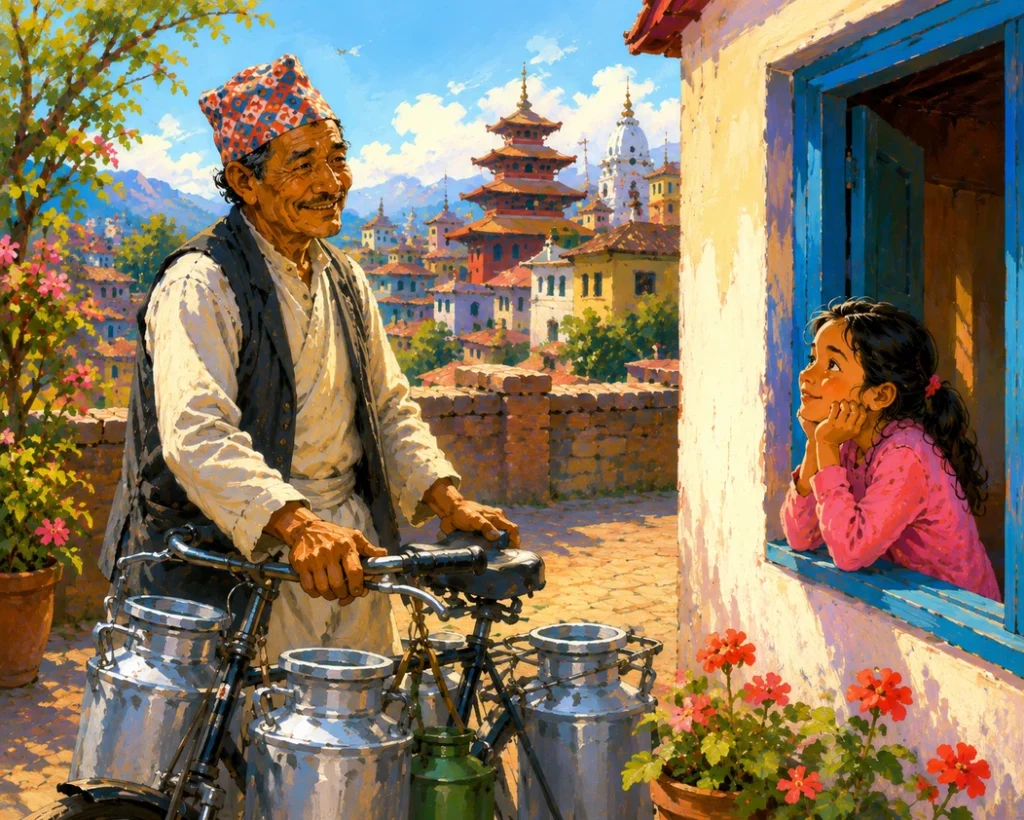
“Why was he always the laughing stock?” she once asked me.
And there it was.
The question we should have asked years ago.
How strange that someone could become so essential to the architecture of our lives and yet remain invisible within it. Morning after morning, year after year, he nourished our household, carried our news, witnessed our growth, and stood patiently outside our gate while we reduced him to a joke.
How often, in the exhausting theatre of life, do we forget the backstage actors?
The ones who arrive before dawn.
The ones who carry burdens quietly.
The ones whose names become routines instead of identities.
My sister and I eventually wrote an email to our mother asking her to give gwala dai our regards.
Even now, I think we are still waiting for the reply.
Author’s Note
This essay was originally written and published when I was in my twenties while living in Perth, Western Australia. An earlier version of this piece was also read at a Writers’ Guild gathering I was part of in Western Australia.
Glossary
- Gwala dai: In Nepali, gwala means milkman and dai means elder brother. The phrase is both occupational and affectionate.
- Daura suruwal: Traditional Nepali male attire, often associated with cultural pride and national identity.
- Topi: A traditional Nepali cap commonly worn by men.
- Maiya: An affectionate Nepali term used for a young girl or daughter-like figure.
- Hangama: A colloquial South Asian term meaning commotion, uproar, or public fuss.
- Illam: A district in eastern Nepal famous for its tea gardens and high-quality tea.
- Tokla tea: A well-known Nepali tea brand commonly found in Nepali households.
- Lagankhel, Chapagaon, Ekantakuna, Jawalakhel, Kupondol, New Road: Places within and around Kathmandu Valley, Nepal.
- Amrikan: A localized pronunciation of “American,” often used humorously or critically in South Asian conversations about westernization.